Sint-Anna
Imagination and adaptive interventions led to the total transformation of a 1970s house into a Californian tree-house encouraging a new way of life connected to nature.


It was lucky then that one evening in a leafy suburb of Kortrijk, Belgium, architect Emiel Vercruysse accompanied some friends to view a house for sale. Seeking a quieter life better connected to nature, the neighbourhood and street seemed to tick every box. The plot was rich in mature trees and a lush surrounding garden – another tick. Yet the blocky 1970s house, divided into two apartments with small windows and low ceilings, unfortunately did not tick any – except for being well-under budget.
As he looked out of a first floor window, Vercruysse however, sensed some potential. It was twilight, and through the sculptural shapes of the trees, slowly becoming shadows, the tiny lights of the undulating suburbs beyond were beginning to light up – reminding him of views over the hills of Los Angeles. At that moment, he imagined a tree-house with 360 degree views and wrapped with floating terraces.
This entailed replacing the roof (more straightforward than one might imagine) to raise up the ceiling heights by half a metre, and carving out wider and more windows for every room. Vital to his vision, was an unconventional switch: shifting the living spaces to the upper, first floor, and the bedrooms to the ground floor, consequently wrapping a concrete entrance staircase around the house leading up to the front door.
As he looked out of a first floor window, Vercruysse however, sensed some potential. It was twilight, and through the sculptural shapes of the trees, slowly becoming shadows, the tiny lights of the undulating suburbs beyond were beginning to light up – reminding him of views over the hills of Los Angeles. At that moment, he imagined a tree-house with 360 degree views and wrapped with floating terraces.
This entailed replacing the roof (more straightforward than one might imagine) to raise up the ceiling heights by half a metre, and carving out wider and more windows for every room. Vital to his vision, was an unconventional switch: shifting the living spaces to the upper, first floor, and the bedrooms to the ground floor, consequently wrapping a concrete entrance staircase around the house leading up to the front door.


After carefully considering the ‘switch’, Vercruysse’s friends, a family with two children, placed an offer on the house, and the rest is history. Each day they continue to be surprised by the transformative experience of living amidst the treetops: witnessing the changing colours and framed variations of light. Picture windows frame views of the landscape and they absorb the evening sun from the terrace all year around.
Responding to the visibility of the shifting seasons, Decancq Vercruysse designed versatility into the interiors, balancing openness for warm summer days, and cosiness for long winter nights. The living spaces are connected in a flowing plan, yet Ash wood slatted dividers can be adjusted to open up views and light, or closed down for quiet and retreat.
Responding to the visibility of the shifting seasons, Decancq Vercruysse designed versatility into the interiors, balancing openness for warm summer days, and cosiness for long winter nights. The living spaces are connected in a flowing plan, yet Ash wood slatted dividers can be adjusted to open up views and light, or closed down for quiet and retreat.


With a chef in the family, the east-facing kitchen is an important place, which illuminates at sunrise for a morning coffee. The generous L-shaped island with a Grigio stone top and glass mosaic sidings, elegantly solves the need for ample storage, whilst becoming a social anchor for informal gatherings with friends.
Further custom furniture includes the walnut dining table with stainless steel legs; the latter, a material used again for a coffee table, the door knobs and lighting details for a cooler touch. Ash wood open-shelving displays personal travel mementos; whilst lay-in carpets bring softness to the otherwise practical sandblasted concrete flooring peppered with visible stones.
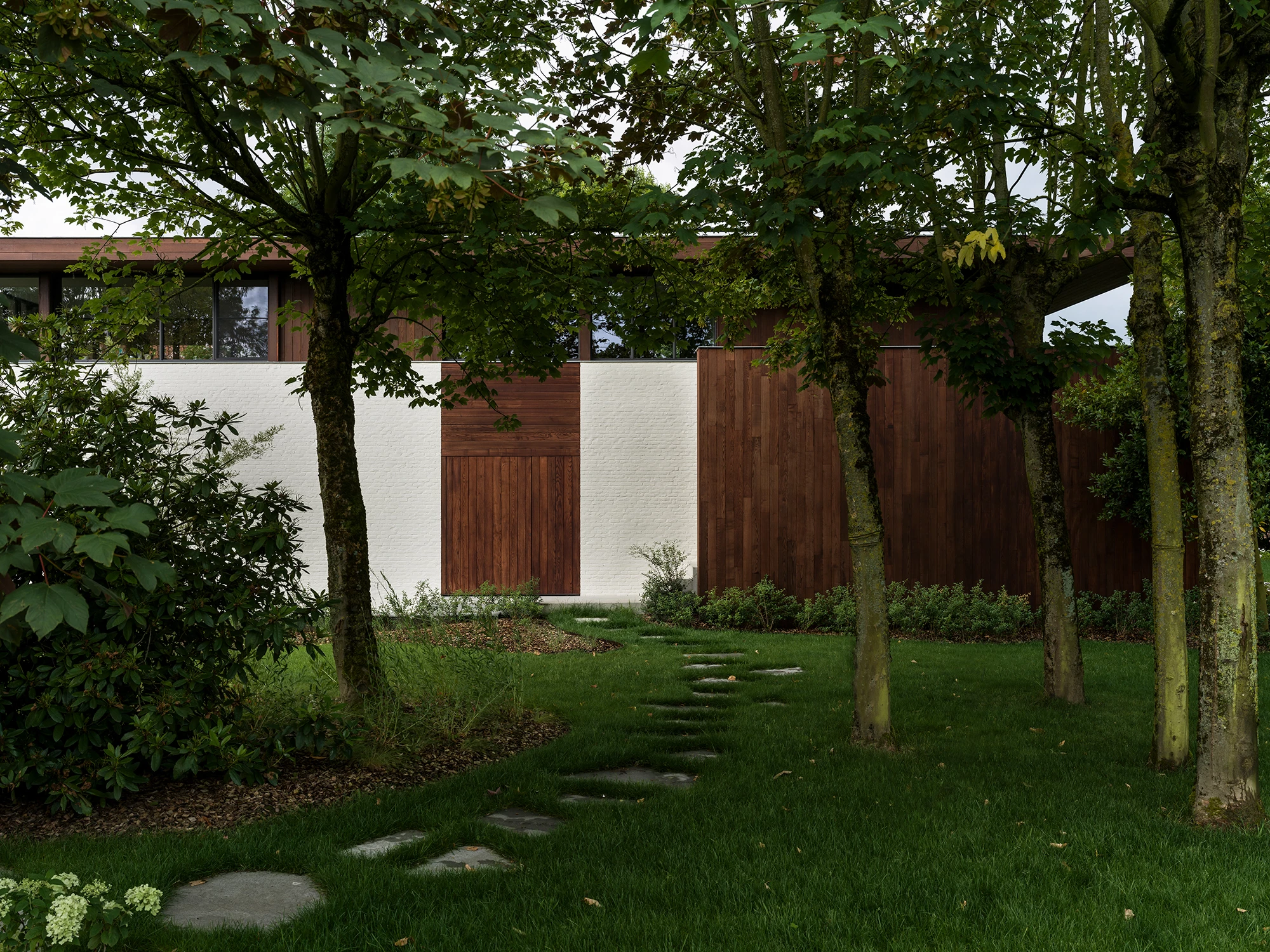
With minimal architectural interventions and a reimagining of the interior plan and materiality, the transformation of this house is total. The brick exterior was white-washed and inlaid with sections of wood panelling that also wrap around the whole upper level; it has a new, warm welcoming mid-century character like a Californian tree-house.
It’s also gained a new way of life, where living outdoors and connected to nature feels easy and rewarding – enhanced by the wooden sauna, hot tub and open-air kitchen to the garden. Each time Vercruysse drops by, as he walks across the stepping stones leading up to the house, he has a good feeling that confirms his original vision.
Further custom furniture includes the walnut dining table with stainless steel legs; the latter, a material used again for a coffee table, the door knobs and lighting details for a cooler touch. Ash wood open-shelving displays personal travel mementos; whilst lay-in carpets bring softness to the otherwise practical sandblasted concrete flooring peppered with visible stones.
With minimal architectural interventions and a reimagining of the interior plan and materiality, the transformation of this house is total. The brick exterior was white-washed and inlaid with sections of wood panelling that also wrap around the whole upper level; it has a new, warm welcoming mid-century character like a Californian tree-house.
It’s also gained a new way of life, where living outdoors and connected to nature feels easy and rewarding – enhanced by the wooden sauna, hot tub and open-air kitchen to the garden. Each time Vercruysse drops by, as he walks across the stepping stones leading up to the house, he has a good feeling that confirms his original vision.

Photograpy Piet-Albert Goethals
« back to homepage